July 7, 2026
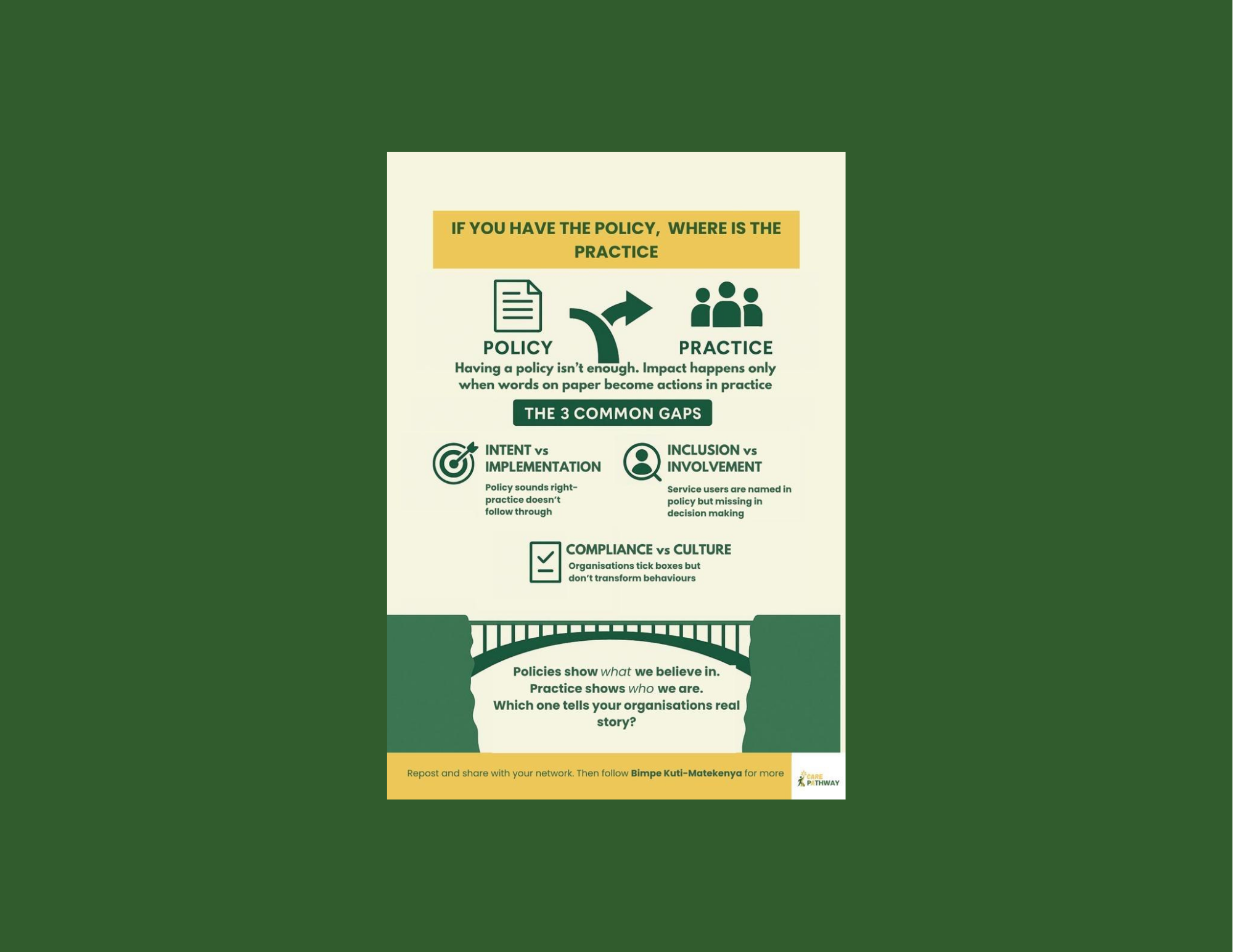
Download Infographic Here
Every organisation says it wants to reduce health inequalities.
Every strategy references prevention.
Every Integrated Care System speaks about neighbourhoods, partnership working and person-centred care.
Yet despite decades of policy, reports and investment, health inequalities remain stubbornly persistent.
Why?
Perhaps we continue to misunderstand where expertise truly exists.
For much of modern healthcare, expertise has been defined by professional qualification, clinical authority and organisational hierarchy. These are all essential. But they represent only one form of knowledge.
There is another expertise that has too often been invited into the room, late into thw planning and decision making stages.
But as expertise.
The people closest to the problem are often furthest from the decision
Reading Andi Orlowski's recent reflections on strategic commissioning resonated deeply with me. His argument is straightforward yet profound.
When financial pressures force difficult decisions, services that appear expensive on spreadsheets are often those serving communities with the greatest need. If decisions are made using cost alone, inequalities become embedded within the system rather than reduced.
Co-design therefore becomes not simply good engagement practice, but a practical safeguard against making poor decisions.
This is where public health and lived experience become inseparable. Health inequalities are rarely created because professionals do not care. They emerge because systems make decisions without fully understanding how people actually experience those systems. Public health is about understanding people's lives, not just their diseases.
As public health professionals, we spend considerable time analysing: population data, epidemiology, demographic trends, risk factors, service utilisation, outcomes etc.. These are indispensable.
But data tells us what is happening. Lived experience tells us why.
Data might tell us that screening uptake is low.
Data may show poor medication adherence.
Statistics identify the gradient.
Without both, we only understand half of the problem.
Throughout my work in higher education, research and health and social care, I have increasingly moved away from asking:
"How do we involve service users?"
Instead, I ask:
"How do we redesign systems so lived experience becomes part of how expertise itself is defined?"
This is a fundamentally different and complex question.
Not because it is a moral obligation (although it is). But because it produces better decisions.
Public health often describes prevention in terms of interventions - Smoking cessation, Vaccination, Screening, Weight management, Health promotion. Yet perhaps the earliest form of prevention is something much simpler.
Listening.
Listening becomes a preventive intervention in itself.
Systems fail less often when they are built with the people who use them. The future workforce needs a different understanding of expertise
One of my goal and reason for showing up at work daily, is preparing the next generation of public health professionals. Technical knowledge will always matter. Evidence-based practice will always matter. But equally important is developing graduates who understand that communities are not passive recipients of services -
If we educate future professionals to value lived experience with the same seriousness as academic evidence, we begin changing healthcare long before they enter practice.
A healthier future requires shared expertise. Health inequalities will not disappear through policy documents alone. Nor through organisational restructures. Nor through another strategy. They will reduce when systems consistently ask a different question:
Who has not yet shaped this decision?
The answer is often the very people living with the consequences of it. Public health has always been about improving the conditions in which people can live healthy lives. To achieve that, we must broaden our definition of expertise.
But lived experience is not supplementary to these.
It is what connects them to reality. When public health, social care, research and lived experience stand alongside one another and not in competition, but in partnership, we move beyond delivering services for people. We begin building systems with people.
And that is where meaningful, equitable and lasting change begins.
.png)