When Real Life Contradicts the Campaign, Belief Wins - Not Science
Why this topic?
I have had the opportunity to attend three patient experience conference this year. I presented at two and won an international award at one of them. I listened to patients, carers, care providers and professionals describe how beautifully written strategies often fail to match the reality of daily experience and interactions in care. I heard colleagues admit that despite best intentions, the gap between policy and practice persists (Read last month’s Newsletter on Policy to Practice). I have also watched people with lived experience powerfully articulate how this gap affects not just service quality, but dignity, confidence, and lives. On my reflection on those moments, I aligned lived experience to public health campaigns. Not as a critique, but as a call to rebuild trust through lived experience led leadership.
In this moment, we are witnessing public health campaigns that are more sophisticated, more evidence-based, and more widely disseminated than ever and reaching us more readily in nearly every space we occupy. Yet, public trust in health and social care messaging does not match the energy of the campaign enough to affect change in people.
Why?
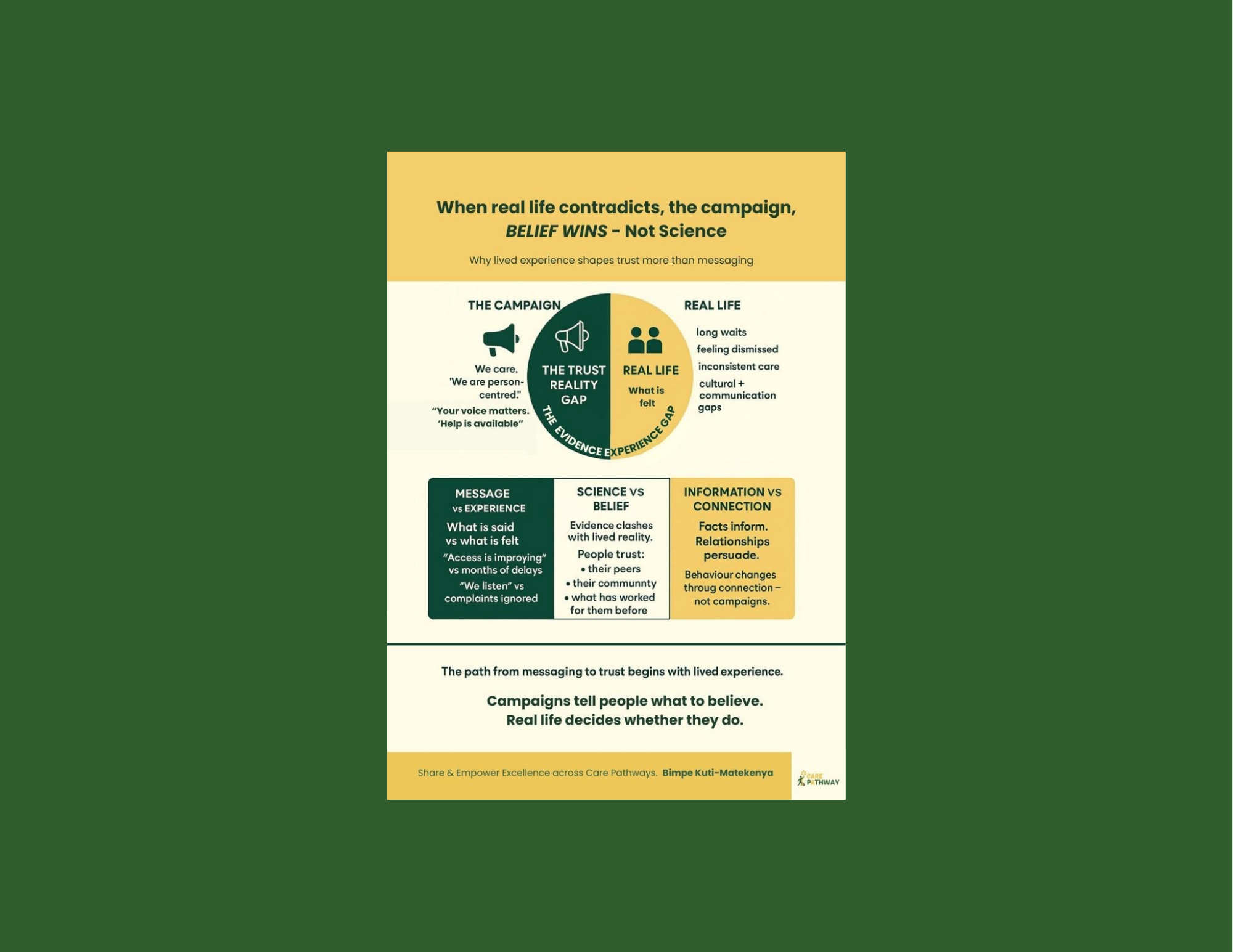
Because when real life contradicts the campaign, belief wins - not science.
As public health professionals, researchers, educators, and social care leaders, we might assume that evidence will “speak for itself.” We craft strategies, design interventions, publish guidance, and disseminate information grounded in data and best practice. This is essential for our practice, without a doubt.
But here’s the uncomfortable truth:
People often do not live in evidence. They live in their experience.
People may not trust campaigns but they will look to people for trust.
People tend not to follow guidance if it contradicts what they see and feel.
Whether a message will land is not because it is accurate, it’s because it aligns with lived reality.
The Evidence–Experience Gap: The Real Public Health Challenge
Every community, every household, every service user and carer navigate complexities that textbooks do not fully capture. When a campaign tells people:
“We are here to help you”, but they can’t get an appointment…
“Your voice matters”, but i hear them tell me - but no one listens when things go wrong...
"Health inequalities are a priority”, but their daily lives keeps showing widening gaps…
“We are a person-centred workforce”, but experiences feel transactional…
These examples fractures trust, but this is not a failure of science. This is a failure of connection.
Public health may provide the what, but lived experience provides the why and the how.
Lived Experience as Evidence
Lived experience is usually positioned as... For example:
a story/examples at the start of a conference
a case study in a presentation
a “patient voice” quote inside a report
a one-off session in a curriculum
While these examples reflects good practice and demonstrates a genuine desire to embed lived experience, they can still remain tokenistic if not accompanied by meaningful involvement, influence, and shared decision-making.
Lived experience is experiential data, it is contextual intelligence, it is evidence of the real-world impact of policies, systems, and services.
SO....
If science tells us what we believe should happen, lived experience tells us what actually does.
It is within this gap that trust can gradually diminish, influencing how people engage with services and whether public health interventions are fully embraced.
Person-Centred Systems Are Built, Not Claimed
Organisations often declare that they are person-centred, but service users can immediately identify when this is not true. So I say that...
Because person-centred care is not branding. It is behaviour.
It shows in:
how decisions are made
who is in the room
who speaks and who is heard
what is funded
what is measured
what is rewarded
A system cannot call itself person-centred while excluding the very people it claims to centre. To close the gap between campaign and reality, shifts to designing things with people and being accountable to people is crucial.
Why Lived Experience-Led Public Health Is the Future
We are entering an era where public health leadership must be:
place-based
relational
equity-driven
co-produced
culturally responsive
contextually grounded
This is my daily work within my roles in education, research, and practice - with a specific focus on service-user and carer involvement, in any aspect of wider public health and social care. I see repeatedly that when lived experience sits at the centre of teaching, policy, and service design:
learning deepens
trust increases
outcomes improve
organisations evolve
culture shifts
Most importantly, it aligns what we say with what people experience, and that alignment is the foundation of trust.
Bridging the Gap: What Leaders Must Do Now
Here are three urgent priorities for public health and social care leaders:
Treat lived experience as equal evidence - Include lived-experience partners in strategy, commissioning, curriculum, research, governance, and evaluation.
Audit the “belief vs science” gap - Where does your organisation’s messaging contradict lived experience?
Where does the system promise what it does not deliver? This gap must be named before it can be closed.
Build cultures, THEN campaigns - Slogans don’t change behaviour. Cultures do. Invest in workforce training, listening systems, reflective practice, and lived-experience leadership pathways.
A Final Thought
Science matter.
Evidence matter.
Campaign matter.
But TRUST, the foundation of all public health is shaped by lived reality.
Public Health systems need to align the science with the experience, the campaign with the truth, and the strategy with the stories of those who live it.
This is for public health and social care leaders, educators, and organisations who believe and understand this, and act on it.
Here’s to building care pathways where everyone gets a fair chance
Here’s to Empowering Excellence
